Main Menu
- Home
- Product Finder
- Calibration Systems
- Calibration Services
- Digital Sensing
- Industrial Vibration Calibration
- Modal and Vibration Testing
- Sound & Vibration Rental Program
- Non-Destructive Testing
- Learn
- About Us
- Contact Us

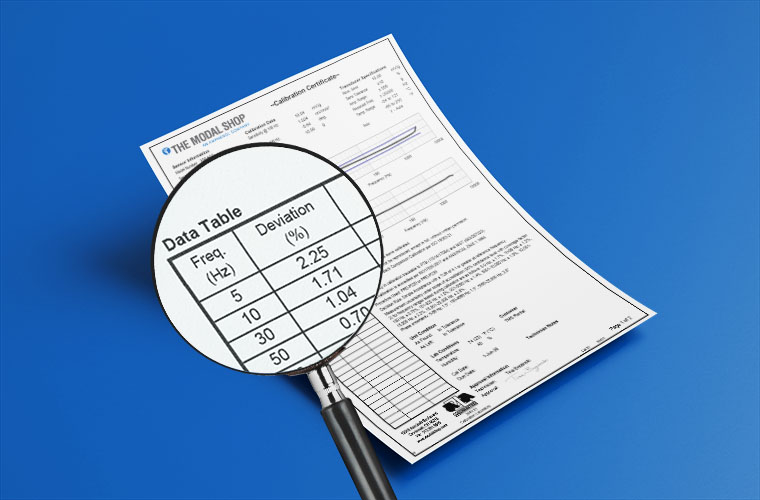
As an ISO 17025 accredited calibration lab, The Modal Shop performs thousands of accelerometer calibrations per year. We often get questions about calibration frequencies, measurement uncertainty, and what calibration results really tell you about sensor performance. Here we’ll dive into a common question:
“If my accelerometer is specified to measure below 5 Hz, why does the calibration certificate start at 5 Hz?" The answer lies in both how piezoelectric accelerometers perform over time and what calibration is designed to verify.
For high-quality piezoelectric accelerometers, such as those manufactured by PCB Piezotronics and available through The Modal Shop, low-frequency performance is thoroughly characterized during product development and manufacturing, and defined by low frequency RC filter electronics design. Specialized testing and tightly controlled manufacturing processes verify that the sensor meets its published frequency response specifications before it leaves the factory.
Once in service, the factors that typically affect sensor performance are generally not related to low-frequency response. Instead, the most common concerns are changes in sensitivity, physical damage, environmental exposure, cable damage, and contamination. These are not expected to selectively affect the low-frequency response. Mechanical damage, mounting problems, and other changes can alter sensitivity or produce changes in the upper-frequency response, while electrical or environmental problems may affect the response more broadly. Seal failure is one important exception, which we’ll explore in more detail later in this article.
Because low-frequency performance is established by design and remains inherently stable throughout the life of the sensor, there is often little additional value in repeatedly verifying it during routine recalibration.
Producing accurate vibration at very low frequencies requires specialized equipment. As frequency decreases, the shaker system must generate significantly larger displacement while maintaining precise motion control. Mechanical distortion, tilt, transverse motion, and environmental influences become increasingly important sources of error.
For example, generating a calibration signal at 1 Hz may require displacement levels many times greater than those needed at 100 Hz. This necessitates large long-stroke shaker systems, specialized reference standards, sophisticated motion measurement techniques, and longer test times.
As a result, low-frequency calibration is substantially more complex, takes more time, and costs more than standard sensitivity verification.
Routine calibration focuses on the parameters most likely to change during the life of the sensor. By verifying sensitivity and frequency response over a standard calibration range, laboratories can confidently determine whether the accelerometer continues to perform as intended.
If a sensor passes these tests, there is typically no indication that its low-frequency response has degraded. In practice, piezoelectric accelerometers rarely exhibit a condition where only the low-frequency portion of the response changes while the remainder of the frequency range remains unaffected.
For this reason, routine calibration provides a highly effective assessment of overall sensor health without the additional complexity of specialized low-frequency testing.
For end users, calibration data ultimately becomes part of the overall measurement uncertainty budget for a test, experiment, or monitoring program.
A calibration performed with lower uncertainty contributes less uncertainty to the final measurement result. Conversely, calibration points with higher uncertainty can increase the uncertainty budget without necessarily improving confidence in the measurement system.
This is one reason calibration laboratories carefully select calibration frequencies. The goal is not to generate the greatest number of data points, but to provide the most meaningful verification of sensor performance while maintaining well-controlled uncertainty.
When specialized low-frequency measurements are required for seismic monitoring, structural health monitoring, or other low-frequency applications, dedicated low-frequency calibration services can be performed. For most typical vibration measurements, however, routine calibration frequencies provide the optimal balance between measurement confidence, uncertainty, and cost.
There is one type of failure that can be seen first at very low frequencies, and that is the failure of the sensor’s seal.
If an accelerometer’s seal is compromised, moisture or contaminants can enter the sensor and potentially reduce insulation resistance or increase electrical leakage. This can alter the sensor's effective electrical time constant and, in some cases, cause a loss of sensitivity or other abnormal behavior at very low frequencies, including
In a severely compromised sensor, the result can be a measurable degradation or loss of low-frequency response, sometimes occurring below the frequency range covered by a standard calibration.
A quick note about sensor sealing: Not all seals provide the same level of environmental protection. Conventional seals can effectively protect against dust, liquids, and larger contaminants, but they may allow microscopic amounts of gases or water vapor to permeate over long periods of time. A true hermetic seal, by contrast, is designed to prevent gas and moisture ingress by creating a gas-tight enclosure. Methods such as glass-to-metal sealing, brazing, laser welding, and soldering can provide this level of protection. For accelerometers, robust hermetic construction helps preserve insulation resistance and electrical performance over years or decades, reducing the risk of moisture-related degradation that can affect low-frequency response.
Sealing methods ranging from relatively simple approaches such as adhesives, epoxy, potting compounds, O-rings, and conformal coatings to more robust forms of enclosure can provide effective protection against dust, moisture, and contaminants for many applications, but they are not necessarily hermetic. Over time, materials such as polymers and elastomers can allow some moisture or gases to permeate, or their properties can change with temperature, age, and environmental exposure. For many applications, this level of protection is entirely adequate; however, it may provide less long-term resistance to moisture ingress than a true hermetic enclosure.
At the highest level of environmental protection, precision accelerometers use a welded, hermetically sealed metal housing with hermetic electrical feedthroughs. Welding creates a permanent, gas-tight enclosure, while glass-to-metal or ceramic-to-metal seals prevent leakage around the electrical connections. A welded, hermetically sealed accelerometer manufactured in a tightly controlled production environment, such as those produced by PCB Piezotronics, provides a high level of protection against moisture and environmental contamination that can compromise sensor performance over time. The controlled welding and sealing processes, combined with rigorous leak testing and quality control, reduce the likelihood of a hermetic seal failure compared with sensors that rely on less robust sealing methods.
Because moisture ingress can reduce insulation resistance, shorten the electrical discharge time constant, and ultimately affect low-frequency response, a high-quality hermetically sealed sensor is less likely to develop the low-frequency performance degradation that would prompt investigation or calibration below 5 Hz. Robust hermetic construction reduces one important source of low-frequency degradation and helps maintain stable performance over the sensor's service life.
If there is reason to believe a sensor’s seal has failed, there are some tests that can identify loss of hermeticity before it significantly affects performance. The most effective approach is to combine:
This combination is much more sensitive to early moisture ingress than any single calibration frequency alone.
A standard accelerometer calibration that begins at 5 Hz is not an indication that the sensor cannot measure below 5 Hz. Rather, it reflects the frequency range in which routine calibration can provide meaningful verification of sensor performance with well-controlled measurement uncertainty. For high-quality, well-maintained accelerometers, low-frequency performance is generally established during manufacturing and remains stable throughout the sensor’s service life. When a specific application requires higher confidence in performance below 5 Hz, or when there is reason to suspect environmental or seal-related degradation, specialized low-frequency testing can provide the additional verification needed.