Main Menu
- Home
- Product Finder
- Calibration Systems
- Calibration Services
- Digital Sensing
- Industrial Vibration Calibration
- Modal and Vibration Testing
- Sound & Vibration Rental Program
- Non-Destructive Testing
- Learn
- About Us
- Contact Us


API 670, published by the American Petroleum Institute, is the benchmark standard for designing, testing, and maintaining the systems that protect critical rotating machinery from catastrophic failure. One of the key goals of API 670 is to ensure that machinery protection systems provide reliable, repeatable measurements that can initiate alarms or shutdowns before equipment damage occurs.
The release of API 670, 6th Edition represents an important advancement for machinery protection system testing and validation. One of the most significant changes for reliability and maintenance professionals is the expanded recognition of portable vibration calibrators for field testing functions involving proximity probe systems.
Historically, portable vibration calibrators were primarily recommended for field verification of accelerometers, velocity sensors, vibration transmitters, and related measurement instrumentation. Testing of proximity probe systems typically relied on static gap calibration combined with electrical signal simulation to verify alarms and protective functions.
API 670 6th Edition now recognizes that portable vibration calibrators equipped with a calibrated reference accelerometer and capable of providing measured vibration amplitude from the shaker can be used for many of the critical field tests outlined in Annex F. This represents a major industry shift toward dynamic testing methods that more closely replicate actual machine vibration conditions.
The standard also references calibration practices aligned with ISO 16063-21, the internationally recognized method for vibration calibration of accelerometers. Unlike single-point verification methods, ISO 16063-21 requires a multi-point calibration approach using a minimum of six calibration points across the operating range. This provides a more complete characterization of sensor performance and greater confidence in measurement accuracy.
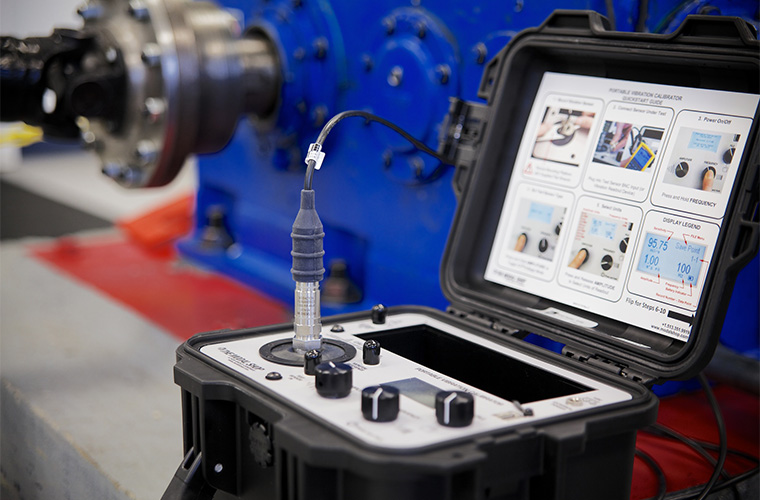 For users of Portable Vibration Calibrators from The Modal Shop, including Models 9110D, 9210D, and C9110D, these updates reinforce the value of performing calibration, verification, loop checks, alarm testing, and proximity probe validation directly in the field. By combining a precision reference accelerometer, closed-loop vibration control, and documented test results, portable vibration calibrators provide a practical method for validating the performance of machinery protection systems while minimizing downtime and reducing reliance on simulation-only testing methods.
For operators in the oil and gas, petrochemical, power generation, and process industries, API 670 6th Edition provides increased confidence that field testing can be performed using methods that more closely represent actual operating conditions, helping ensure the reliability and effectiveness of critical machinery protection systems.